
Claude Does SEO
I have always done a subpar job of SEO because I find it tedious and I am lazy. Claude finds nothing tedious and is generally less lazy than I, so seems like a good fit!

I feel compelled to start this post with two apologies. First, I did not post anything in either of the last two weeks. If you were sitting with bated breath each Thursday waiting for the latest from The Automated Operator, you were disappointed and it is entirely my fault. Sorry! Two weeks ago my toddler got sick, and while he recovered in one day, I caught his illness and spent a week hacking up a lung. Last week was more positive — I got into escrow on the largest acquisition since starting my business, which should be closed by the time this post goes live.
My second apology is because this post is about using AI to add slop to the internet. I do not feel good about it! But the older I get, the more I prioritize practicality over principles, and the reality here is that I am not moving the needle in the grand scheme of slop. If throwing some AI-written pages up on an e-commerce website blog drives a few extra sales (and gives me a new task on which to judge AI capabilities/write a Substack post), then that’s what I shall do. I beg your forgiveness.
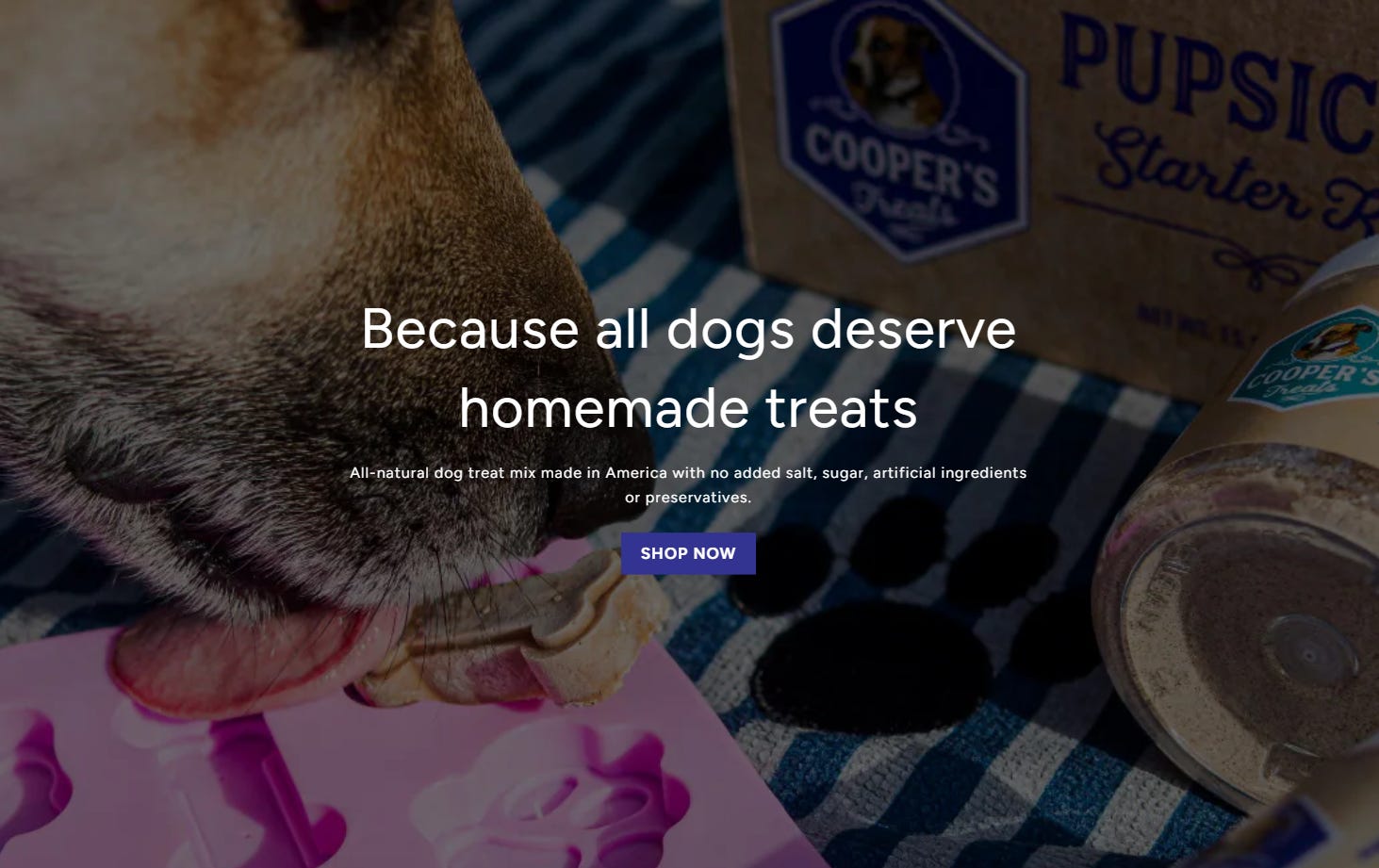
My first foray into e-commerce was during the pandemic, when I decided to start a business making dog treats. That business is Cooper’s Treats, and it sells frozen dog treat mix — basically a powder in a jar that you mix with water and freeze. I began with a Shopify store and found customers mostly through Meta ads.
I knew that SEO was important, but it wasn’t really my area of expertise. I did the basic stuff I was aware of, which mostly involved alt tags on images, a few blog posts with some relevant search terms and a bunch of outreach to try and get links. The last effort was somewhat successful, and I even made it on some local news segments.
Still, customers came in from organic search at a pace for which “trickle” is perhaps too generous a description. I focused on Meta ads and email marketing, found some loyal customers and still make a little money from the business today. For the most part, though, I have entirely neglected the Shopify site (most of my sales come from Amazon now) as I’ve moved into buying other e-commerce brands.
Enter Claude
A month or so ago, I was in the shower (the location of most of my best thoughts) and realized that Claude could probably do SEO better than I. I don’t have the exact prompt I used, but it was something along the lines of:
I have a Shopify site for Cooper’s Treats. I don’t really know much about SEO. Can you do SEO stuff for it?
Never be afraid to ask dumb questions!
Unsurprisingly, the answer was yes. It gave me three general categories of work it could do:
SEO cleanup and optimization. Get rid of test pages that I published but never linked from the site, make sure all the images have alt text, set SEO titles and meta descriptions, etc.
Run through my Google Search Console results and publish a bunch of
informative blog postsslop about dog-related search queries.Reach out to other websites to inquire about having them link to mine.
I went with options one and two. Having my AI agent start emailing people is a bridge too far for me. Adding blog posts to the internet isn’t great, but at least it isn’t directly annoying people. I’m not totally devoid of principles!
First things first, Claude needed access to Shopify and Google Search Console. For the former, I created a Shopify app, got a list of necessary permissions from Claude, installed it to my store and then gave Claude the credentials. I have since learned that there is already a Claude connector app that I could’ve used, so if you want Claude to do anything to your Shopify site, I’d recommend that. Claude already has a Google Service Account to access my Sheets and Docs, so I added that to the GSC property.
From there, it spun up some subagents and ran through everything. On Shopify, you will not be shocked to hear that it found plenty of areas for improvement. The first few products I launched were in good shape — I was enthusiastic and diligent about everything back then — but most of what I added after starting the business was missing the absolutely basic stuff you’re supposed to do for SEO.
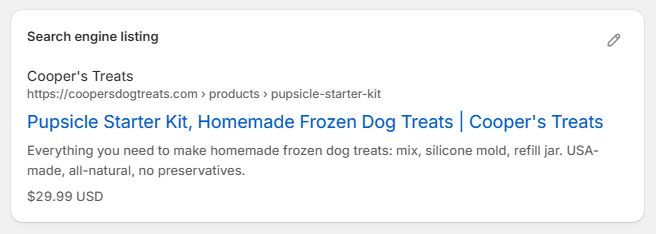
This was really a perfect task for AI. The scope and requirements are clear, the work is incredibly repetitive and tedious, and it can’t quite be done by deterministic code because you need some intelligence to write appropriate titles and other text. Claude came back with a list of proposed changes, I briefly eyeballed them and said go, and it just fixed everything. I spot-checked some changes, but at this point I have high enough confidence that Claude can manage straightforward API calls that it’s just not worth the time to review all of its work.
Next up, blog posts. When I launched the site, I researched and wrote a number of “Can dogs eat <food>?” blog posts, primarily about the ingredients in my treats. I honestly have no recollection of why that’s the direction I went, but some of them performed okay in terms of ranking and traffic, though those visitors very rarely converted to customers.
Still, Claude saw that and figured it’d pick up where I left off with a lot more foods, and when the cost is effectively zero, even a barely-converting page has great ROI. It also came up with several other topical areas tangentially related to my products and proposed more articles. In the end, it had a list of a few hundred blog posts to write.
I asked it what the best strategy was for putting those out, and it said that dumping hundreds of posts in one day would probably trigger some negative treatment from Google. It instead set up a daily job to put up one article, plus, at my request, a weekly email update with information on the performance of the pages it fixed up for me plus the new posts.
It’s been a few weeks, and so far the results are solid. No massive influx of traffic, but clicks and impressions are both up. The existing pages that it cleaned up have moved up in search results, and I’ve even seen a couple of sales. This has been neither glamorous nor exciting, but it’s the kind of grinding productivity that helps in the long run.
What Does This Tell Us About The Future of SEO, Work and E-Commerce?
While I have made light of the fact that I’m adding AI slop to the internet (and I am sure some people will be legitimately angry over it), the reality is a nigh-infinite amount of SEO-related slop was created before AI was a twinkle in Demis Hassabis’ eye. I once worked at a startup called UpCounsel that was a marketplace for lawyers, and one of our main avenues of customer acquisition was tens of thousands of programmatically-generated pages titled “Top Ten <practice area> Lawyers in <City, State>,” each of which had a whole lot of template text with a list of lawyers pulled from our database that matched the title (or were close enough — there were a lot of city pages and we did not have ten lawyers from Stone Mountain, GA).
We can argue over the degree to which that was bad, but the fact is that just creating a web page for your product is no longer enough for Google to rank you anywhere that you’ll ever be seen. SEO is an arms race, and taking a principled stand against participating just means that people will end up buying inferior products with superior search marketing.
The good news is that AI offers a couple of ways to improve the situation. First, it evens the playing field. If everyone can employ Claude to do SEO, then suddenly spending a lot of time, effort and money on SEO stops being a competitive advantage. This is, I think, a good thing. The ideal state of commerce is the one in which people find and purchase the best products for their needs as opposed to the best-marketed. When the one-man shop with a great product can compete with large enterprises that employ well-funded marketing teams, the economy and consumers are better for it, even if there is collateral damage by way of slop.
On the other side of the transaction, there’s the possibility that everyone’s personal AI will be able to find the right product for the person using it. The reason that being highly-ranked in Google’s search results matters is that nobody has the time or willingness to go through pages and pages of links in hopes that there’s a hidden gem buried in there somewhere. Your AI agent, on the other hand, has time to spare. It’s not crazy to think that it can constantly be scanning every new site that pops up online related to your interests. When it’s the middle of summer and somebody launches a new brand of frozen dog treats with flavors your dog loves, perhaps you get a notification.
Perhaps I’m naive and AI will simply make everything worse, but until I’m proven wrong, I will hold out hope that everyone having an intelligent, tireless agent who knows all of their preferences will make finding things on the internet better.
There is one other point that I think is worth taking away, which is that this represents a class of job that is fully automatable, or very close to it. If you have a website with a large enough number of pages, you have at least one full-time job’s worth of SEO to do. It’s worth paying a salary to have someone constantly monitoring all of the things that go into Google’s ranking algorithms and ensuring every page is optimized, because any movement in your position in search results means an immediate corresponding change in your revenue.
None of that work, though, is deeply complex. There is a lot of it, and it takes understanding and intelligence to do, but it’s well within the grasp of today’s models. While economic and labor data continues to paint a very ambiguous picture of the effects of AI, as someone running a small business, I keep seeing places where AI is unambiguously able to replace humans. I could’ve (and probably should’ve) hired someone from Upwork to do this work for me. Now there’s no need.
Much ink has been spilled over the idea that AI will free us from the tedious work and let us move on to bigger and more interesting things, but what happens when the whole job is tedious work? If you have someone doing the rote, day-to-day SEO work, and then you suddenly realize that actually Claude can handle it, do you move your SEO employee up and have them do high-level tasks, or do you let them go and tell their manager that they’re now managing an instance of Claude to handle SEO instead? I know which option I’d put my money on.