
Predictions for 2026
And a plea not to take things for granted

As the year comes to a close, I want to put some AI-related predictions down on paper (or, y’know, pixels). Mostly for my own sake — things are moving so fast that it’s easy to forget how recently image gen models couldn’t even get people’s hands right (per ChatGPT, Dec 20, 2023 was when Midjourney v6 was released and was the first model to really have them nailed).
Before I start predicting, though, I want to make a request of you, dear reader: do not become acclimated to what AI can do. I don’t mean this in a practical sense — of course you should get used to using these tools in ways that improve your work and life — but rather that you should maintain a sense of wonder about just what they can do.
The most surprising thing about AI to me isn’t its capabilities; it’s how fast they just become normal to people. People who embrace AI as I do can spend hours using AI to write code or solve problems or generate images without thinking about how truly insane it is that you can just talk to the computer and get real, valuable answers and products and pictures. People who hate AI condemn everything it produces as slop with no regard for the fact that much of the slop they hate would take hours of human labor to create (and that’s by skilled humans; I couldn’t produce an AI-slop-quality image with a month uninterrupted). Meanwhile I’m over here shouting at my wife every day: “MAGGIE CAN YOU BELIEVE IT JUST MADE THIS?? THIS IS UNBELIEVABLE!!”
So whether you love it or hate it, I really do encourage you to remember that it is, at least by the Arthur C. Clarke definition, magic. I can ask for a picture of a living room decorated for Christmas, and it just… appears. I can ask for a set of recipes for a meal and get one that incorporates the ingredients in my fridge and accounts for the appliances I have in my kitchen and ties three courses together thematically. I can ask for an application that speeds up work that I’m currently doing by hand, and the computer codes it up in a few minutes. These things are miraculous!
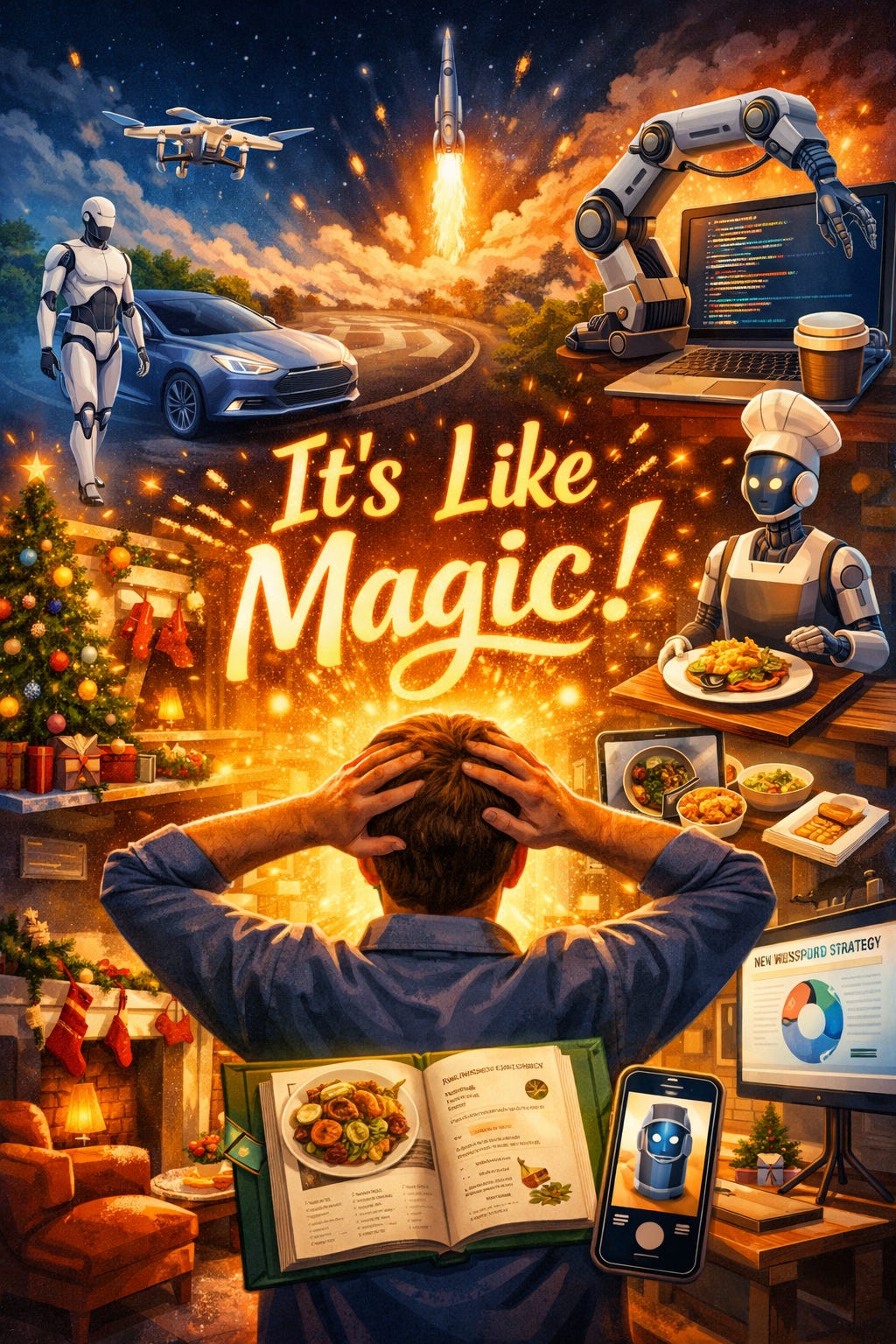
It is, barring nuclear war or some other major event that dramatically changes the course of human history, more or less a certainty that in the near future we will have widely available self-driving cars and humanoid robots and AI coworkers. Maybe the near future is 2-3 years or maybe it’s 10-15, but even in the latter case that represents a transformation that will be witnessed by the overwhelming majority of people alive today. These things have gone from speculative sci-fi to solvable engineering problems. Whether that excites you or horrifies you, don’t take for granted that these things and the pace at which they are coming is not normal. Maintain your sense of awe and childlike wonder. Ask yourself, once in a while, how you would’ve reacted 10 years ago if shown the technology of today. I strongly suspect the answer wouldn’t been with a “meh, but the models still hallucinate sometimes.”
Predictions
Thank you for indulging me thus far! Onto some predictions. First, some context: I am neither an expert forecaster nor privy to any nonpublic information. My main method of predicting the future is by plotting the points of the past and drawing a line through them. I am mostly writing this to get an immutable record of my thoughts down, so I can look back and see how far off I was.
Computer Use Agents
In January of 2025, Jensen Huang said “AI agents are going to get deployed. I think this is the year we’re going to see it take off.” I’d say he got that one wrong. I spent some time testing agents this year, and they were neat but by no means production-ready.
I will caveat that by saying that the term agent is, like AGI, so ill-defined as to be pretty useless. Some folks would consider Claude Code to be an agent, in which case they’d understandably have a different perspective on how agents went this year than I do. For my purposes, I’m going to consider agent to mean a computer-using, web-browsing agent. I can give it a task, and with the same basic set of tools that a remote employee has, it can go accomplish that task.
To that end, agents today are more of a research preview than a real tool (though in an effort to maintain our childlike wonder here, let’s not forget to be amazed that I can ask an agent to go browse the internet and gather information for me, and I can watch it click around in a browser and do that!). Next year, though, my bet is they surpass the reliability threshold necessary to be legitimately useful.
Let’s put a little bit more specificity to that prediction: I think you will be able to ask an agent to do a task that requires planning, research and interaction with multiple pieces of software and get a result that you are comfortable relying on for work purposes. Some example tasks:
Do research on a topic. Write a two-page memo about the topic that is tailored to a specific set of stakeholders, and create a presentation on the topic in Google Slides with speaking notes for the presenter.
Create a piece of software and put it on the internet. Given a lightweight set of requirements, plan and build a piece of software that fulfills those requirements. Acquire a domain and hosting, and get the software live so people can use it.
Prepare the marketing for a b2b SaaS product launch. Given access to internal documentation about a software product (along with general access to other internal file storage/knowledgebases as well as the internet), along with a dev environment in which you can use that product, create the following:
An internal training doc
A battle card for sales comparing the product to competitors
A sales deck
A product page for the company website
Perhaps this is a bit too optimistic, but it feels to me like we’re close. We’ve already got strong capabilities around writing documents, creating decks and coding webpages. The remaining pieces needed are the ability to take a task like this and create a plan that breaks it down into small units of work (though arguably Claude Code is already there) and to navigate the web and use internal tools reliably enough to gather the necessary info from different websites and software tools.
Image Gen
Given the pace of improvement of AI image generation, my prediction is that it’ll be effectively solved in 2026. The original Nano Banana was launched on August 26 of this year. It was very impressive from a technical sense (excellent image quality, solid at following instructions and handling direction, the first model that could do a decent job at targeted edits of input images) but not good enough to be practical for anything beyond making stock photos and illustrations for Substacks.
Less than three months later (November 20), we got Nano Banana Pro. I can personally attest that it had hit the point of being legitimately useful for commercial purposes. Not only could it take a crappy iPhone photo of a product and use it to generate professional-quality whitebox and lifestyle photos, but it also suddenly had the ability to generate infographic-style images that adhered to detailed prompts with directions on text, style and layout. The latter was something that, if you had asked me at the launch of the original Nano Banana, I would’ve predicted as coming in 2027.
NBP still has some issues. Sometimes it just gets stuck and keeps generating the exact same image when you ask it for changes. It does sometimes make errors with text (misspellings, duplication). For product photos, it won’t always stay true to the real-life appearance of the product. It can’t generate accurate product photos of text-heavy products (e.g. packaging with a lot of text).
Still… magic! I’ve been generating new listing images to A/B test for all of my Amazon products, and every single time, it’s just jaw-droppingly good.

The left image above is one I paid a guy on Upwork for. The right image is Nano Banana Pro. Just mind-blowing stuff here.
Anyway, let me nail down some specifics for this prediction, especially as it relates to my use case. I believe that with 90%+ accuracy, leading image models will be able to:
Make precise targeted edits requested with no other modifications to an image
Generate product photos in which the product appears true to life, including for text-heavy products/packaging
Demonstrate flawless adherence to a prompt; that is, for any practical level of detail (I will exclude excessively long prompts that exist solely to test adherence but don’t have any real commercial use case), get the composition and style exactly as described on the first try
Economic Impact
I hesitate a bit to make economic predictions both because I have lower confidence in them and because it’s harder to isolate the effects of AI from all of the other economic forces. But hey, not like the Fed’s reading this, so why not?
I think 2026 is the year that we really start to see AI impacting the labor market, and the place where it’s really unambiguously going to show up is in low- to mid-level contract work. Basic design, photography and writing tasks on platforms like Upwork will decline in volume significantly. Small businesses will increasingly save money by replacing freelancers with generative AI for their marketing. Large businesses will be slower to adopt these tools unless there is a significant economic downturn, in which case adoption will be accelerated.
A concrete prediction: economic reports from developing countries will note that there has been a tangible impact on GDP due to the loss of jobs outsourced from the US.
Entry-level hiring of full-time positions will also continue its decline; that already appears to be happening with software development and customer support jobs, but expect it to increase both within those areas as well as more broadly to places like marketing, data analysis and legal.
2026 Is Gonna Be Wild
Progress in AI, both in terms of technical advancement and its spread into everyday life, has been accelerating for a few years now, and that’s only going to continue in 2026. More and more people are going to have their equivalent of my experience with Nano Banana Pro — suddenly it becomes very clear that AI can do economically valuable work that previously would’ve required a human.
Some folks will lose their job because of that, and others will build new businesses around it. Facility with AI will be the main skill that matters, and anyone who is adept with AI and also possesses deep expertise in some important domain will suddenly find himself leaps and bounds ahead of his peers.
That said, most people in the world still won’t be doing much with AI (at least directly; most will interact with AI regularly in ways that are opaque to them). I recognize that sounds like it runs counter to everything I’ve just said, but the reality is you can have a world in which millions of jobs are lost and industries shift in meaningful ways as a result of AI, but most people just don’t use it in their everyday life. They keep Googling things instead of asking an LLM, and they have no idea that over the course of the year they’ve seen thousands of AI-generated images.
For those of us who are constantly trying to keep up with AI, 2026 should be a wild year. For a lot of other folks, it’ll be scary, and for yet others it’ll just be more of the same. Regardless of who you are or what role AI plays in your life, though, the reality is you’ll almost certainly become inured to its capabilities; breakthroughs in March will feel normal by June.
And so I will close the year by once again asking: please remember that none of this is normal. The fact that computers can just create the things you ask them to is a jaw-dropping demonstration of human progress. When you find yourself annoyed because the infographic that Nano Banana Pro Max Ultra produced is missing one of the factoids you told it to include, just remember that two years ago, creating that infographic was a full day’s work for a good designer, not a 30-second wait and a cost of eight cents.
It is a truly insane time to be alive.
Hey, great read as always. Wonder is key, but productivity... so tempting.